Most "High-Achieving" Men Feel STUCK...And We Don't Have To
It Actually IS
Possible
to Break the Hidden
Patterns
Holding You Back In Your
Marriage
,
Your Job,
and Your
Growth
Research Shows “Success” Doesn't Lead to Happiness—Worse, Cultural Expectation and Modern Psychology Reinforce Patterns That Can Damage Relationships (and Make Life Miserable).
Here's How To Fix It.
If the term “high achieving” at the top of the page caught your eye, you’re in the right place.
And if that’s how you think of yourself, it tells me a lot of things about you. On paper, at least.
Chances are, you’re competent. Capable. Respected. You’ve built things. You’ve achieved things. You’ve figured out how the world works — at least enough to carve out your place in it.
You’re not drifting. You’re not lost. You’re not one of those guys blaming the system for everything that didn’t pan out.
You’ve taken responsibility for your life.
And yet.
If you fall into the majority, then like most high-achieving men, there’s that thrum of dissatisfaction, the low-grade frustration that doesn’t go away.
A 2008 paper on well-being outlined the U-curve of life satisfaction, showing that men experience the least happiness when they’re at their best: in the 20 year period in the middle of their lives.
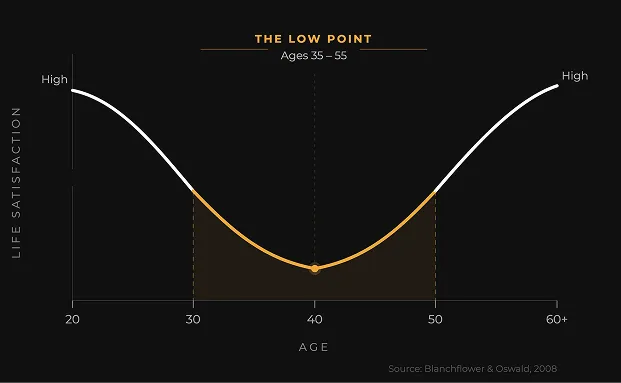
Even though they may seem to have it all, even though they’ve finally got the family, the job, the car, the stability, this is the lowest point for so many of us.
A synthesis of more data on this subject reveals that at least 50% of men over 35 (and especially those between 45-55) experience “midlife dissatisfaction.” It’s a general malaise, that quiet desperation Henry David Thoreau described.
For many, it’s not loud enough to call it a “crisis.”
But all that means is that the discomfort and happiness they feel is somewhat tolerable; not bad enough to do something dramatic like buy a sports car and date someone half their age.
What I’m saying is that there’s a 50% shot you’re not quite miserable enough to justify blowing your life up, but constantly wrestle with a quiet, persistent sense that something keeps repeating…
…and you don’t fully understand why.
There’s a particular kind of misery in realizing you are back in the same place again.
Same fight. Same tension. Same emotional geometry.
Maybe the details change. Maybe the conversation starts in a different room, with different words, on a different day. But before long, you can feel the pattern locking into place, and some part of you already knows where it ends.
That is what starts to exhaust you.
Not just the conflict itself. Not just the aftermath. The repetition. The humiliating familiarity of it. The fact that you’ve seen this movie before: you know the lines, you know the cues, you know exactly when it starts going off the rails—and still somehow find yourself participating in it again.
You get defensive. Or distant. Or hard. You start arguing like a man trying to win on points instead of solving a problem.
You withdraw. Sometimes you posture. You manage perception. You say what’ll protect you in the moment instead of what might actually move the thing forward. Then later, when the nervous system comes down and the dust settles, you can see the whole sequence with painful clarity.
Which, in some ways, is worse.
Because it’s not that you do not know better.
It’s that knowing better has not yet translated into being different when it counts.
That’s the maddening part. You are not a fucking idiot. You are not unaware. You are not stumbling blindly through your own life with no pattern recognition. Quite the opposite. You can often see the thing while it is happening. You can feel yourself doing it. And yet some older, faster, more deeply grooved part of you reaches for the same move anyway.
That’s the kind of shit that makes a man start to distrust himself.
All this despite the fact that, from the outside, your life probably looks more or less fine.
You handle your responsibilities. You produce. You show up. You are not in visible collapse. But privately, you know there’re moments where some automatic piece of you grabs the wheel, and once it does, the rest of you is left watching the same old sequence play out.
The sarcasm when you feel criticized.
The withdrawal when you feel misunderstood.
The need to dominate when you feel challenged.
The over-functioning when you feel your worth being evaluated.
This is And every time it happens, it costs you something.
Not always all at once. Usually not all at once.
That’s the danger.
Not because your life is collapsing. Because it probably isn’t.
The real danger is almost always slower than that. More ordinary. Less cinematic. Most of what people eventually call a crisis was, for a long time, just a pattern they learned to live with. Something tolerable. Something manageable. Something they kept telling themselves was not ideal, sure, but not bad enough to force a reckoning.
And that’s how people lose years.
Not usually through catastrophe, but through erosion. Through the slow degradation of structural integrity under repeated stress. Through pressure applied to the same weak points over and over until the thing that once looked minor becomes impossible to miss.
That is how marriages break down. Rarely in one grand explosion. More often through a thousand repetitions of the same unresolved dynamic. A thousand small failures of repair. A thousand moments of distance, resentment, defensiveness, control, silence.
Friction becomes tension. Tension breeds alienation. Alienation begets contempt. And by the time people admit something’s badly wrong, the damage has usually been accumulating for years.
The same is true at work. The same is true in family life. The same is true in your relationship to yourself.
Everything in the universe obeys certain laws. One of them is that nothing maintains itself indefinitely by accident. Left unattended, things drift. They decay. They break down. Anything not being strengthened is weakening. Anything not being repaired is degrading. Anything merely “not that bad” is moving, however slowly, in the wrong direction.
That’s the problem with living inside the same cycle over and over—the aggregate cost.
Cracks widen into crevasses. Faults become fissures.
What feels manageable now becomes costly later.
The argument you know how to survive becomes the marriage you no longer feel safe inside. The professional compromise you keep making becomes a reputation. The silence becomes disconnection.
The coping strategy becomes your personality.
And then one day you look around and realize the life you built is being quietly shaped by patterns you were sure were temporary.
That’s how a man wakes up in a life he does not fully respect.
Not because he blew it all up in one spectacular act of self-destruction. Because he kept repeating what was familiar until it became fate.
That’s why this matters.
Because you’re not confused about what you want. You want closeness instead of tension. Respect instead of quiet resentment. You want to be able to stay clear, grounded, and dangerous in the best sense of the word when pressure rises, instead of becoming some lesser version of yourself right when it matters most.
And if you keep finding yourself in the same loops, despite your intelligence, despite your self-awareness, despite all the times you have sworn next time will be different, then the issue is not motivation. It’s not discipline. It’s not that you need another podcast, another insight, another fleeting burst of resolve.
It means there’s a pattern underneath the pattern.
And until that changes, the rest of it won’t.
And you know that. You know you’re operating below your potential in the moments that matter most.
You’re not confused about what you want.
The sarcasm when you feel criticized.
The withdrawal when you feel misunderstood.
The need to dominate when you feel challenged.
You’re not confused about your goals.
You’re confused about why, despite your intelligence and effort, you keep defaulting to the same moves—especially under pressure.
That confusion is the signal, it’s the sign that there’s an opportunity to change.
Because what you’re experiencing isn’t a motivation problem, a discipline problem, or even a trauma problem.
It’s a pattern. Just a pattern.
And, as Jung told us: until you understand the pattern, you’ll keep reliving it.
How Modern Psychology Keeps
Successful Men Stuck
A lot of psychological terms have worked their way into everyday language.
Look anywhere on social media and you’ll find people with no credentials, no training, and very little experience freely labeling certain behaviors as “narcissistic” and nonchalantly telling their audiences that anyone who has a bad day is toxic.
Those are the worst examples. But much of what you see is benign—and because it’s “less serious,” it’s easy not to take it seriously. It’s easy to dismiss it.
We read about defense mechanisms, trauma responses, and coping strategies: three very diagnostic terms that more or less describe the same thing—how people react to difficult situations.
This isn’t necessarily bad, as these terms aren’t exactly wrong. The problem is that they represent a very singular form of categorization.
Because they’re all taken from psychotherapy, they force us to view our behaviors through that singular lens.
The scope narrows; our ability to examine things broadly disappears.
Everything is “trauma.” Everything stems from childhood wounds. And if that’s the case, anything we want to change, we need extensive long-term psychological healing, or repeated trips to the jungle for plant medicine ceremonies, or a complete reinvention of the self.
Our cultural overuse of these terms more or less forces people who want to help others to view the entire enterprise one way: the mind.
I know. I was one of those people.
Brilliant People Make the
Same Mistakes As Stupid People
When I got what seemed like a dream gig consulting for a company run by three partners, I was excited in a way it’s hard to describe.
On paper, it was the kind of engagement you’re proud to have. Smart founders. Real revenue. Real momentum. These weren’t amateurs. They were seasoned, financially successful men who had built something substantial together.
They’d built something incredible. But I’d come to learn…they actually kind of hated each other. By the time I got involved, they were quietly at war.
I didn’t see it at first. They presented themselves as a strong unit. And they’d taken intentional steps to create that unit.
Two longtime partners had already realized where they were running into repeated conflict, and they thought the best way to solve it was to bring in a junior partner, someone who had skills they lacked, or who might balance out the dynamic.
This is like a struggling married couple deciding to open the relationship and bring in a third person to spice things up. Might work for a while, but it actually just complicates things and makes everything worse.
More people, more personalities, more moving parts. More complications. More conflict.
There was more of everything, except patience, skills, and progress.
Every time the company faced meaningful stress—a stalled deal, a strategic disagreement, a personnel issue—the same pattern emerged.
One of them went nuclear. He became aggressive, authoritative, confrontational. Under pressure he raised his voice, dominated the room, framed it as decisiveness. And to be fair, that style had helped him build the company.
Another shut down. He went quiet in meetings and later sent carefully worded emails dissecting what went wrong. Strategic. Methodical. Almost chess-like. But in conflict, he disappeared — and because he disappeared, the other two ignored him.
The third operated socially. Charming, perceptive, good at reading people. But when tension rose, he maneuvered instead of confronting. He appeased one partner while subtly undermining the other. He built alliances. He managed perception.
The aggressive one despised him for being manipulative.
The social one framed the aggressive one as unstable.
The quiet one tried to clean up the damage.
And every single time stress entered the room, they defaulted. They weren’t choosing these behaviors. They were reverting to them.
My job was to mediate and translate. I believed that if I could increase awareness—if I could help them see each other clearly—they would adjust.
They didn’t.
We had breakthrough conversations. Moments of real understanding. And then, a week later, a new stressor would hit and we were right back in the same loop.
Same escalation. Same aftermath.
After a month of this, I was exhausted. Fielding late-night calls. Translating emotion into strategy. Trying to get three highly intelligent men to respond instead of react.
The most frustrating part was that they weren’t reckless or self-destructive. They were disciplined in most areas of life. Good fathers. Good husbands. Financially stable.
They just could NOT get out of their own patterns.
Eventually, those patterns fractured the partnership. The company splintered.
And I had to confront something uncomfortable.
It wasn’t that they lacked intelligence. It wasn’t that they lacked insight. It’s that none of that was enough. They were all clear what the other was doing, but blind to their own patterns.
Under stress, they weren’t operating from cognition.
They were operating from something older.
And I didn’t yet have the right language for it.

My name is JD Garrett.
For years, I’ve worked with high-performing founders, executives, and driven men navigating high-stakes conflict—in their companies, in their marriages, and inside their own heads.
My background began in cognitive and nervous system work. I became deeply immersed in understanding trauma responses, attachment styles, and the mechanics of emotional regulation.
I built my reputation helping intelligent men articulate what was happening internally and translate emotional chaos into practical action.
But what changed everything for me was realizing that awareness alone wasn’t enough. I watched smart, successful men repeatedly default to the same patterns under pressure—even after they could name those patterns perfectly.
That forced me into years of studying evolutionary psychology, behavioral science, and neurobiology to understand what actually drives behavior when the stakes are high.
This led me to meet one of the smartest and most emotionally intelligent human beings I’ve ever come across, my partner Ben. (INSERT BEN BIO)
The result of our joint research and work together birthed the methods we now use to help men through our company Beyond Fight or Flight.
Years of study helped us uncover the 12 Approaches framework—and ultimately Tactical Evolution, a system built not just on insight, but on Recoding the strategies men deploy in every interaction.
These days, we look at helping men work through their patterns through a kaleidoscopic prism. I’m fascinated by all the ways systems interact with one another to either unravel issues or make them worse.
But that wasn’t always the case.
Like most people, the first several years of my coaching career, I had that single lens.
It was all driven by principles used in therapy. That’s how I viewed people and their challenges. My view was that humans, because of our cognitive development, were, well, brains first and foremost. Everything attached to those brains was mechanical. Bodies existed to carry our brains around.
I became very good at working inside that framework. I built real expertise in nervous system and body-based work. I came to deeply appreciate how powerful and important those systems are.
But something kept bothering me.
If awareness alone created change, the men I was coaching should have transformed quickly.
Most did.
But some…well, some very much did not.
Ben Cardell
Your Paragraph text goes Lorem ipsum dolor sit amet, consectetur adipisicing elit. Autem dolore, alias, numquam enim ab voluptate id quam harum ducimus cupiditate similique quisquam et deserunt, recusandae. here
JD Garrett
Your Paragraph text goes Lorem ipsum dolor sit amet, consectetur adipisicing elit. Autem dolore, alias, numquam enim ab voluptate id quam harum ducimus cupiditate similique quisquam et deserunt, recusandae. o
The Edible and the Epiphany:
How Getting High and Watching the Nature Channel
Changed the Way I Think About Everything
That experience with those three clients was so frustrating.
No matter how I tried to coach them, no matter how much we talked and processed and tried to get to a place of resolve and understanding, every one of them held to their patterns.
They were three smart and successful men being coached by another pretty smart guy (me!) and all of them regressed to a terrible version of themselves every time there was a disagreement.
I started questioning everything.
I’d explained the issue. I’d sat with each of them and helped them understand where the issues came from. They listened and nodded. In those moments, they got it.
They were fully aware of the issues. Nothing helped.
If awareness creates change, why wasn’t it working? If naming the trigger solves the trigger, why were we still stuck?
After about a month, I was exhausted. Constantly translating their words to each other. Mediating. Getting emails and phone calls at all hours. It felt like I was trying to manually override something that simply didn’t want to be overridden.
One night, I had a serious case of the fuck-its.
I turned my phone off. Sat down in front of the TV. Poured a glass of mezcal and ate a 5mg edible.
Maybe getting into a Don Draper mentality could help me figure this out. Except I never made it to Mad Men.
Instead, I wound up watching Blue Planet.
And nature revealed itself to me.
There I am—just a wee bit intoxicated—watching birds dance to impress other birds. Watching lizards camouflage themselves to throw off predators. Watching chimps form alliances to improve their odds of mating and survival.
And it hits me.
THAT’S what I’m missing.
Not everything is brain-based. Not everything is the mind.
Like all animals, humans have survival instincts, and we react to them just as strongly. If animals don’t all have a human level of cognition, then it simply can’t be true that cognitive psychology can explain all of animal (and human!) behavior.
That night, something clicked.
Here’s what I saw:
Every single action we take in our lives is an attempt to optimize for a successful outcome we’re trying to achieve. Every one, every time.
And most of the time, we don’t even realize it.
In times of distress, every reaction is an attempt to create one outcome: safety. To return to homeostasis.
We’re constantly trying to move toward benefit and away from consequence.
We commonly refer to this as being in a “fight-or-flight” state. And that’s not wrong—it’s just woefully incomplete.
The problem is that we’ve been taught to think of fight-or-flight as a state we enter only when things are B-A-D bad. Those terrible moments when we feel like we’re going to lose something. When we feel like we’re in danger.
But as I realized that night in front of the TV (and later verified through years of study) this is NOT true at all.
Some part of us is always in some version of that state.
That’s when I understood that I had been coaching at the level of cognition…while something deeper was running the show.
And if I wanted to actually help high-achieving men break their patterns, I needed to understand that deeper system.
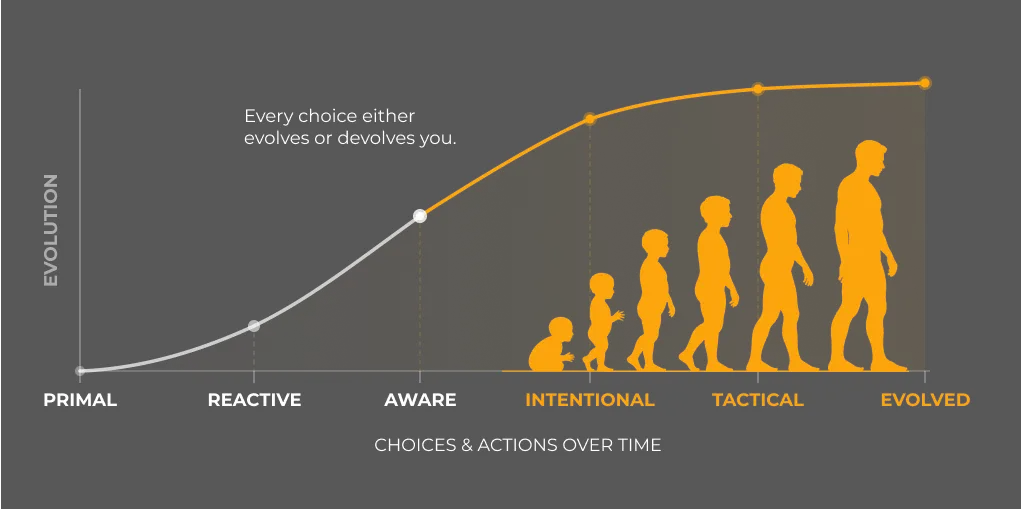
Beyond Fight or Flight
While our brains eventually evolved to create language, build cities, invent world-changing machines, and do all the other things that make humans the dominant species on the planet…
…that’s new technology. But that brain is built on top of older (biological) technology.
Beneath the cognitive brain lies the instinctual brain—systems present in mammals long before humans walked upright. Beneath that is the same nervous system architecture that causes single-celled organisms to recoil from electrical signals.
And those systems are just as powerful (and just as active) in your everyday life as the three-pound sponge sitting in your skull.
We don’t face predators very often anymore. Most of us aren’t in physical danger on a daily basis. The decisions we make usually don’t mean the difference between a full belly and starvation.
But those deeper systems designed to assess for danger don’t shut off. They adapt.
We didn’t evolve not to need them. They evolved to guide us differently.
The threats changed. They’re no longer lions and rival tribes. They’re status. Reputation.
Belonging. Influence. Authority. Intimacy. Security.
And what we’re trying to achieve the outcomes we’re trying to influence, they’re not life or death in the physical sense, but they’re no less important.
They’re your marriage. Your job. Your ability to lead. Your place in the hierarchy.
Your evolutionary biology didn’t disappear when civilization showed up. It integrated with your cognitive systems.
And instead of responding to claws and teeth, those systems now respond to criticism in a meeting. To emotional distance at home. To feeling disrespected. Sensing that your authority is being challenged.
Which is why it’s so much more than fight or flight.
We don’t just respond to challenges with a binary choice of either engaging in glorious battle or turning tail and running.
And the other two you’ve probably heard about (freezing or fawning) don’t even cover half of it.
Over time, my research uncovered something much broader.
There aren’t four stress responses.
There are TWELVE universal approaches humans deploy in every single interaction.
Every conflict.
Every negotiation.
Every tense conversation.
Every moment where something is at stake. Which, in our monkey minds, is nearly every moment.
We don’t just fight or flee. We merge with allies to establish unity and belonging. We seek or create distraction when we’re facing problems we don’t feel ready to deal with.
We tend to those we love not just to show care, but to increase our value in the relationship. We blend into the background when visibility feels dangerous.
We shapeshift when navigating power structures, subtly adjusting who we are to maintain influence.
And here’s the part most people miss:
None of these are inherently good or bad.
Every single approach can express itself in adaptive (or pro-social) ways.
Every single one can express itself in maladaptive (or anti-social) ways.
The same “fight” instinct that makes you decisive and protective can make you domineering and volatile.
The same “merge” instinct that makes you loyal can make you codependent. The same “blend” instinct that keeps you safe can make you invisible.
The issue isn’t the strategy, but the rigidity. The unwavering adherence to a particular strategy even when all evidence suggests it’s going to make the entire situation worse.
Most of us have this experience, probably more often than we realize. And for good reason. When you default to one or two approaches (especially ones that worked for you early in life) they become automatic.
Anything automatic starts embedding itself into your sense of identity.
And identity is when you go from “that’s just how I am” to “that’s just who I am.”
But it’s not who you are; it’s just where you are. And you’re keeping yourself there, stuck.
Why Successful Men are Often The Most "Stuck"
While I could never help those three partners understand this, and their partnership collapsed from all the in-fighting, it taught me a powerful lesson.
In fact, it was a life-changing lesson, one most people never learn: the patterns that have led to your greatest successes are the hardest to break.
Because those successes provided your nervous system with evidence.
You see, if intensity helped you build your career—if pushing harder, speaking decisively, refusing to back down earned you revenue and respect—your biology logged that as a winning move.
If being the stable one, the provider, the unshakable one made you indispensable at home, that became a proven strategy.
If staying quiet and reading the room protected you early on, invisibility became intelligent.
Over time, this isn’t what you do, it feels like who you are.
You don’t see yourself as deploying “fight.” You see yourself as strong.
You don’t see yourself as merging to preserve connection. You see yourself as loyal.
You don’t see yourself as blending to avoid conflict. You see yourself as easygoing.
And because the strategy works most of the time, you double down on it.
That’s the trap.
When a pattern works 80% of the time, you stop questioning it.
But the 20% where it fails carries disproportionate cost.:
The same aggression that built your company might be eroding your marriage.
The same self-reliance that made you competent might be isolating you from real intimacy.
The same adaptability that helped you navigate hierarchies might be keeping you from ever moving to the next stage—getting to that next level of success, of happiness, of satisfaction.power struggle.
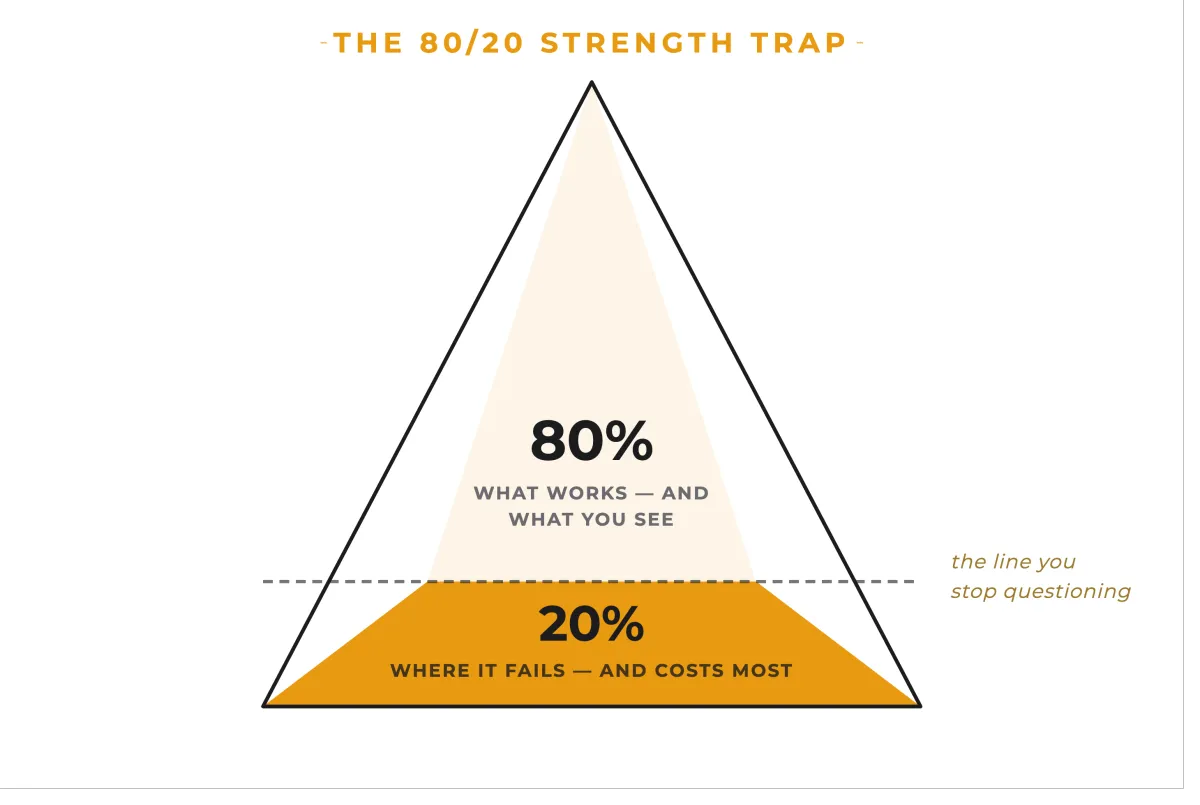
In other words, the same set of reactions that helped you build the life you have are keeping you from the life you want.
Which is why you need to stop reacting and start responding. You need to learn to Recode.
But before we dive into that…
The One Place You Can't Hide From Yourself
Everything we’re telling you applies everywhere in life.
If these patterns only showed up once in a while, or only in low-stakes situations, they’d still be frustrating.
But that’s not how this works.
The same loops that quietly limit you at work, create tension in your decision-making, or make you less effective under pressure tend to become most obvious, most persistent, and most painful in one place above all others: your intimate relationships.
That’s not because relationships create these patterns. It’s because they expose them.
At work, you can compensate with competence. You can rely on performance, timing, structure, status, or sheer productivity to cover a lot.
In friendships, there’s often enough distance to keep certain parts of yourself untested. In public, most people are interacting with a version of you that’s filtered, managed, and selectively revealed.
But in a committed relationship, there’s nowhere to hide.
The person across from you sees you tired, stressed, insecure, reactive, proud, avoidant, defensive, and raw. They’re not interacting with the edited version. They’re living with the full operating system. Which means the patterns you can sometimes finesse or outrun in other arenas become much harder to escape at home.
That’s why relationships are so revealing. And it’s why they’re often where the real confrontation begins.
Because while these patterns affect every area of life, they tend to cost the most in the places where the stakes are highest and the distance is gone. A mediocre meeting can be recovered from. A strained friendship can drift. A bad social interaction can fade.
But the atmosphere inside your relationship doesn’t stay neatly contained.
It spills into your sleep, your nervous system, your confidence, your parenting, your ability to think clearly, and your sense of whether the life you’ve built actually feels good to live inside.
When Trying Harder Makes Everything Worse
Sometimes the problem feels like Groundhog Day. You’re stuck in a loop, but not fully awake to it. The same dynamic keeps replaying, and because it’s familiar, you keep assuming it’ll somehow resolve itself, or at least remain tolerable. You do nothing, and nothing changes.
Other times, though, it feels more like quicksand.
You know something’s wrong. You do try to fix it. But whatever you reach for only seems to drag you in deeper. The problem is no longer just repetition; it’s that repetition no longer brings the same result.
You can’t just “do life harder.” Trying just makes it worse.
It looks like this:
You try to explain yourself, and it lands as dismissal.
You defend your intent, and it sounds like deflection.
You try to fix it quickly, and the other person feels managed instead of understood.
You create space, and they experience abandonment.
You hold your ground, and now you’re not in a conversation anymore—you’re in a power struggle.
That’s what makes this kind of pain so maddening. It’s not merely that you have a pattern. It’s that your attempts to solve the problem are often being generated by the very same pattern that created it.
So now the thing you reach for in order to make it better becomes the thing making it worse.
This is why intimate relationships can feel so unforgiving. The stakes are higher, the exposure is constant, and the feedback is immediate.
Years ago, during a coaching call in the early Covid period, when people were trapped at home with fewer distractions and nowhere to run from themselves, one of my clients said something that stuck with me:
“If I could just stop rolling my eyes, I swear to God my wife and I’d fight 50% less.”
That sounds almost laughably small until you understand what sits underneath it.
The eye-rolling wasn’t the real problem. It was the visible symptom of something deeper: distrust, contempt, chronic self-protection, the belief that if he didn’t take control, things would fall apart. It wasn’t just a bad habit. It was an entire posture.
And that’s how this usually works. The visible behavior is rarely the deepest issue. The deeper issue is the logic beneath it—the reflex, the adaptation, the internal strategy that may once have helped you survive, but now all but guarantees that the same pain will keep getting recreated in new forms.
That’s why relationship pain is so consequential. Not just because it hurts, but because it spreads. If your relationship feels brittle, cold, adversarial, or one wrong sentence away from another blowup, very little else in life remains untouched by that reality.
It affects:
And like most serious problems, it usually doesn’t get worse all at once.
It gets worse gradually, through repetition, through failed repair, through the slow accumulation of stress and disappointment. Most men don’t lose connection in one grand catastrophe. They lose it in increments—through defensiveness mistaken for strength, control mistaken for leadership, withdrawal mistaken for peace, and a hundred moments in which their reaction made perfect sense to their own nervous system and terrible sense to the person standing in front of them.
By the time they realize how much damage has accumulated, they’re no longer dealing with one argument or one bad season. They’re dealing with a climate. A relationship that’s adapted around injury. A life that, from the outside, may still look intact, but from the inside feels increasingly tense, narrow, and deprived of warmth.
Of course, no relationship is perfect, and no relationship problem belongs to only one person. The other person has patterns too.
But your leverage is where it’s always been: with you.
Because when trying harder keeps making things worse, the issue isn’t effort.
It’s approach. We’re here to change that approach. Most importantly, to teach you how to decide on what to approach to take for the best outcome in any situation.
That means changing your patterns. Not facing your patterns can cost you the most; change creates the greatest return.
Of course, no relationship is perfect. And you’re not the only one in it, which means you’re probably not the only one who needs to break some patterns.
But you can only focus on you, and that’s who we’re here to help.
When it comes to relationships, there are some hard truths to face in terms of your patterns.
Hard Truth #1:
The Definition of Insanity Isn’t a Joke—It’s How Most
Men Handle Conflict
To truly change the way you engage with your life—both challenges and opportunities—you need two things: awareness and action.
As we covered above, purely cognitive approaches don’t prepare you for that; not quickly enough.
If it did, everyone in therapy would know how to avoid new problems instead of paying hundreds of dollars a week to talk about their old ones.
All the self-help books in the world don’t give you a real action plan for improvement; mostly they just help clarify the issue.
That’s where most of us are. Stuck. Even the most successful people you know.
If you’re one of the few who’ve “done the work,” you can probably recognize where you default to intensity, avoidance, appeasement, or control.
You need to evolve. That’s a slow process.
We sped it up when we created Tactical Evolution
This is the most thoughtfully structured environment where awareness becomes recalibration.
Over the course of 90 days, we systematically retrain how you engage under pressure — in your marriage, in leadership, in negotiation, in the moments where your biology would normally choose for you.
This is not therapy. It is not venting. It is not talking in circles. It is deliberate behavioral expansion. You learn to see the approach you’re deploying in real time, understand why it’s showing up, and—most importantly—choose differently.
Insights from the World’s
Most Famous Divorce Lawyer
James Sexton, who makes his living cleaning up the aftermath of failed marriages, puts the problem with brutal precision:
“Did you stop paying attention because the relationship didn’t make you happy, or did the relationship stop bringing happiness because you stopped paying attention to it?”
That question lands because it cuts straight through the fantasy that relationships usually die in some dramatic, easily identifiable moment. Most of the time, they don’t. They decline the way almost everything declines—gradually, through neglect, drift, and the accumulated effects of not addressing what keeps repeating.
That’s the Groundhog Day problem inside a marriage. The same tension. The same unresolved friction. The same failure to repair. Not catastrophic enough to force immediate action, but corrosive enough to quietly degrade the bond over time.
That’s also why repeated conflict is so dangerous even when it seems manageable. A couple can survive a lot of bad nights. What they usually can’t survive forever is the steady erosion of goodwill, respect, and emotional safety that comes from the same injuries being reopened without resolution.
What Sexton’s pointing to is that attention is not decorative in a relationship; it is structural. When attention goes, connection goes with it.
And once that starts happening, people often misread the problem. They assume they’ve “grown apart,” when in reality they may have simply stopped tending to the thing while telling themselves it was still fine.
Hard Truth #2:
Appeasement and Avoidance Don’t Eliminate Struggle
“Happy wife, happy life.”
When your default Approach is one intended to maintain calm, this might feel true.
It makes sense, especially if you consider yourself practical. You care about fewer things. She cares deeply about more. So the math feels clean: if it matters a lot to her and not much to you, why create friction?
You’re the external provider. You face the world. You handle the stress, the competition, the sword fights out there. She’s responsible for the internal world—the sanctuary.
If she’s happy, the house feels calm. In the short term, that works.
You outsource decision-making in small ways. You defer. You suppress preferences because they don’t feel worth the argument. You tell yourself you’re being mature.
What you don’t see is the slow shift in the power dynamic.
When you consistently defer, you create an unspoken hierarchy of needs. Hers are immediate. Yours are optional. Over time, that imbalance becomes the structure of the relationship.
Add children, and the shift intensifies. Your needs drop further down the list. You work harder. Provide more. Speak less. You become the engine, not the participant.
And something subtle begins to happen.
She stops seeing you as a co-leader.
You stop feeling fully seen.
You lose more and more of yourself in the relationship while being expected to work harder to maintain it. It becomes a zero-sum game. You feel like a martyr; she feels like a victim of your eventual frustration.
Because here’s what eventually happens.
You reach a threshold and finally speak up. Maybe even explode.
Not because you want control, but because you’re tired of disappearing. And when you do, you’re blamed for creating the dynamic in the first place. You’re told you never had an issue before. You’re accused of changing the rules.
But you didn’t change the rules.
You were dying quietly.
Appeasement feels like peace. Avoidance feels like maturity.
But the attempt to avoid conflict with suppression leads to disconnection, discontent, and usually divorce.
Repression breeds resentment. Recoding leads to revitalization.
Here’s What Can REALLY Kill
What We Love Most
Sexton has another line we find useful here:
“Make the holes you dig shallow, because the deep ones are hard to climb out of.”
This is the quicksand problem. Not merely that conflict happens, but that the way most people try to handle it often makes it worse.
A defensive explanation becomes a bigger argument. A contemptuous gesture becomes a two-day freeze. A minor rupture becomes a referendum on the whole relationship. This is what people miss when they imagine relationship breakdown as a function of giant betrayals or singular disasters. More often, the damage comes from depth charges dropped in moments of reactivity, then left unrepaired until the terrain of the relationship itself changes.
That’s why small patterns matter so much. Not because every eye-roll or shutdown or cutting remark is fatal on its own, but because repeated injuries alter the emotional architecture of the relationship.
Over time, the ground changes. People become more defended, less generous, quicker to assume bad intent, slower to reach for repair. What could have been a shallow hole becomes a trench. What could have been a trench becomes a canyon. And eventually the couple is no longer just arguing about dishes, sex, money, tone, parenting, or time. They’re living inside a relationship that has adapted around injury.
Sexton’s advice matters because it names the truth most people learn too late: the danger is rarely one terrible moment. It is what happens when the same moments are allowed to deepen.
Tactical Evolution is learning to avoid these issues to begin with, and—more importantly—to solve them once they’ve occurred, instead of making them worse.
Hard Truth #3:
A “Solution” Is Not Resolution
This one is harder for high-performing men.
I get it; you’re wired to fix things.
When conflict arises, your instinct is to find a way to deescalate, to land the plane, to get through it. To restore things to baseline.
You talk it out. You explain your perspective. She explains hers. You compromise somewhere in the middle. You both agree to move on.
And technically, the argument ends.
You feel productive. Efficient. Like a damn adult.
Except nothing actually changed.
Solution is NOT resolution.
Resolution means the conflict doesn’t repeat in the same way. Resolution means the pattern shifts. Resolution means that next time stress rises, you navigate it differently because there’s greater understanding of what each person needs, what their patterns are, and what the best outcome would be.
It’s not just about getting back to baseline. It’s about improving that baseline.
This can seem counterintuitive, but minimizing friction is not what makes a relationship thrive. Getting through conflict as quickly as possible is not the same as learning from it so it doesn’t happen again.
Many marriages are defined by having some version of the same argument over and over for years, because most men are sourcing for peace instead of connection.
What if you could actually resolve what’s at the core of that repeated tension? What if you had the tools to address it and put it to bed?
What if you never had that argument again? Even if you’ve had it repeatedly for the past several years?
That would change a lot in the relationship.
And if you don’t?
Your partner feels like you’re dealing with her instead of meeting her. Like you’re managing the situation instead of engaging in it. Like you’re trying to close the support ticket instead of understanding the pattern.
And because the underlying Approach never shifts, the outcome won’t either.
If you can Recode your behavior, you redesign the entire relationship.
90 Days of Structured Behavioral Reconditioning
This is not a weekend workshop. It's not a short course you forget after two weeks. You'll spend 90 days deliberately interrupting and replacing your default patterns — long enough for real Recoding to occur.
With our guidance, this is enough time for real change to take hold, and your internal patterns to shift from reaction and become response.


Weekly 90-Minute Live Coaching Calls
Every week, we meet live for a full 90-minute session. These are not lectures. They are tactical breakdown environments where we:
- Apply the Recode Method to real conflicts and scenarios
- Deconstruct patterns happening in your marriage, leadership, or team dynamics
- Identify your default approaches under pressure
- Practice recalibration in real time
- Expand your behavioral range deliberately
You don't just understand the theory. We help you train it.
(Note: all calls are recorded so nothing is lost. Obviously.)
180 Daily Tactical Video Trainings
You'll receive two focused training videos per day — one each from JD and Ben — for the full 90 days. That's 180 total tactical breakdowns. We don't expect you to watch every one right away. Our goal is to give you a library you can refer back to for years.
Each short video of 5–10 minutes covers a single topic designed to help you spot weaknesses or hone skills. You'll learn how to:
- Sharpen pattern recognition
- Reinforce the Recode loop
- Break down real-world applications
- Expand nuance in conflict navigation
- Build unconscious competence
This daily repetition is what shifts Recoding from concept to instinct.


Private Cohort Community (Telegram)
You'll be placed in a private cohort group where application happens in real time. Inside that space:
- You can bring live situations as they're unfolding
- We spot loops while they're happening (not weeks later)
- You receive feedback and course correction
- You learn from other high-performing men navigating similar patterns
- Accountability becomes natural because everyone is training
This is not a passive chat or a place to share memes. Think of it as a behavioral training ground. (Note: yes, we also share memes.)
Weekly Live Q&A
In addition to the coaching calls, each week there's an additional live Q&A call, during which we:
- Address specific situations
- Refine edge cases
- Adjust strategy in nuanced dynamics
- Pressure-test your recalibration skills
You won't be left guessing how to apply this in complex situations. We'll collect as many questions as possible upfront, so there's no dead air. It's in the moment feedback or a deeper dive into some of the most profound challenges men experience when they work on themselves.


Structured Implementation Framework
Each week includes structured exercises built around the Recode Method:
- Receivesharpening observational awareness
- Reflectclarifying meaning and patterns
- Refinemicro-testing assumptions and narrowing variables
- Realignmaking deliberate decisions under pressure
This ensures you're not consuming information.
You're retraining response.
The Five Domains Framework
You'll also receive the Five Domains growth framework — a structured self-assessment and planning tool that evaluates:
Because recalibration inside relationships must align with growth across your entire life.

What This Is Not
We’re not here to bitch and whine. Yes, we’re here to support one another and bask in the wonderful benefits of community and understanding.
But unlike most programs offering any kind of self-development, this one was built by two guys who understand the importance of iteration to achieve progress. There are specific skills and ways to assess how effectively you’re learning and implementing.
This is a structured behavioral expansion system designed to move you from unconscious default to conscious recalibration.
By the end of 90 days, the goal is simple: you no longer react automatically; you respond deliberately.

Tactical Evolution:
The 90 Day Recoding Program to Optimize Your Approach To Everything
To truly change the way you engage with your life—both challenges and opportunities—you need two things: awareness and action.
As we covered above, purely cognitive approaches don’t prepare you for that; not quickly enough.
If it did, everyone in therapy would know how to avoid new problems instead of paying hundreds of dollars a week to talk about their old ones.
All the self-help books in the world don’t give you a real action plan for improvement; mostly they just help clarify the issue.
That’s where most of us are. Stuck. Even the most successful people you know.
If you’re one of the few who’ve “done the work,” you can probably recognize where you default to intensity, avoidance, appeasement, or control.
You need to evolve. That’s a slow process.
We sped it up when we created Tactical Evolution
This is the most thoughtfully structured environment where awareness becomes recalibration.
Over the course of 90 days, we systematically retrain how you engage under pressure — in your marriage, in leadership, in negotiation, in the moments where your biology would normally choose for you.
This is not therapy. It is not venting. It is not talking in circles. It is deliberate behavioral expansion. You learn to see the approach you’re deploying in real time, understand why it’s showing up, and—most importantly—choose differently.
Tactical Evolution guides you through that life-altering process of change using our Recode Method.
This is what teaches you to pause and think, “Which strategy should I deploy here?”
Currently, your nervous system chooses based on past reinforcement.
That’s recursion.
A recursion loop is when something folds back on itself, reinforcing aspects iteratively.
Your patterns have been strengthening themselves for years. Every time an approach worked, it reinforced itself.
Every time it partially worked, it reinforced itself.
Even when it failed, if it felt familiar, it reinforced itself.
You’ve been recursively programming your own rigidity.
The Recode Method interrupts that loop and replaces it with a new one: a conscious recursion that builds flexibility instead of reinforcing default reactions.
It unfolds in four stages:
First, you Receive. You gather information through observation — environmental cues, tone shifts, behavioral markers, micro-signals most people ignore. Instead of reacting immediately, you expand your intake.
Second, you Reflect. You clarify your meaning. You examine patterns, inconsistencies, probabilities. You ask, “What is actually happening here? What am I assuming? What outcome am I optimizing for?”
Third, you Refine. You narrow the pattern through better questions, micro-testing, deductive filters, and behavioral logic. You don’t just interpret — you test. You adjust..
Fourth, you Realign. You make a thoughtful decision in real time. You adjust your tone, your tactic, your level of intensity, your approach. You choose deliberately rather than defaulting reflexively.
Now you can Recalibrate; make real, impactful decisions about how and when to shift.
What initially requires conscious effort begins to feel natural, fluid, nearly automatic.
During the program, you’ll develop the ability to intuitively Recalibrate — optimizing for the best possible outcome without needing to consciously walk through every step.
Think of it like learning to drive.
When you first got on the road, you were in a state of real high level thought.
Those first few weeks, you were constantly thinking: “hands in the right place; check my blindspot; put on my signal; slowly merge; watch out for brake lights.”
When you’ve been driving for years, all of that happens automatically, often while you’re checking your phone and eating a snack.
The point is, you moved from conscious awareness to unconscious competence. That didn’t happen overnight, but it did happen, and it changed everything about driving. It just took practice and exposure.
That’s what we’ve created with Tactical Evolution: an environment where you can learn, practice, and get feedback to improve the most important thing in your life—how you show up.
Over 90 days, you’ll observe how you move from reflexive reaction to thoughtful response.
Through Tactical Evolution, you’ll Recode your programming, optimizing for outcomes that your previous approach kept just out of reach.
“I'd read every book, listened to every podcast. None of it stuck because I never understood why I kept defaulting to the same patterns under pressure. The Recode Method showed me the mechanism, not just the advice.
“Ninety days ago I would've called this soft. It isn't. It's the most rigorous, evidence-based work I've done on myself, and the only program that's actually changed how I operate under stress.
“My wife noticed the difference before I did. Not because I'm "communicating better" in some scripted way, but because the reactive version of me shows up less and less. That's the actual win.
Your Investment:
What’s the Value of Breaking Your Patterns?
If you were to hire a high-level executive coach to help you navigate leadership blind spots, you’d expect to pay anywhere from $2,500 to $5,000 per month. Often much more.
(In fairness, they can write it off. But a six-month contract for $30k is nothing to sneeze at.)
Again, I like to think in terms of relationships.
Couples therapy is usually the first thing people think to try when they find themselves stuck in challenging relational patterns. Sometimes it even works!
But it’s not cheap. Depending on where you live, meeting with a couples therapist just once per week for three months can run you between $2,000–$4,000.
If you’re lucky, you’ll be able to find someone who actually understands behavioral systems who makes real recommendations for improvement instead of just moderating arguments.
This is rarer than you’d think. A friend of mine described the couples therapy he and his ex-wife attempted to try to save their marriage as, “paying to break up slowly.”
Yikes.
Naturally, your behavior is the thing we’re most focused on. And probably where you’ll find the most options.
Let’s say you want to try a blitz approach and sign up for some high-end men’s retreat focused on emotional growth and relational depth, you’d likely spend $3,000–$10,000 for a long weekend where you mostly just do push-ups and scream in the woods.
Some people like that kind of thing. I’ve heard of a lot of people coming back from those weekends with new friends and new awareness of their problems, and almost none coming back with new skills.
That’s not us.
Tactical Evolution is not a weekend. It’s not talk therapy. It’s not motivational energy.
It’s 90 days of direct behavioral retraining. It’s 90 days of pattern Recoding.
Let’s break that down in plain terms.
You're getting:
12 live 90-minute coaching calls
Weekly live Q&A access
180 daily tactical training videos
Direct coaching inside a private cohort
Structured behavioral implementation frameworks
The Five Domains growth system
90 days of guided recalibration
If this were sold as any executive performance coaching, or relationship optimization, or leadership recalibration, or nervous system retraining…
…you could easily justify $2,000 to $5,000 for this level of immersion.
This is all of those things, because it’s an integral theory.
Here’s our stance: the VERY full of men who need to make real change in their lives, and a lot LESS full of people who can invest $10K without breaking the bank.
We love working with successful men; we just don’t measure success solely by what they take home at the end of the week. This is a program most people can comfortably afford, and that matters.
Now, the standard tuition for Tactical Evolution will be $497 for the full 90-day experience. And that’s a bargain by any stretch.
But this inaugural cohort is different.
You’re not just joining the program.
You’re helping shape its foundation.
You’re getting founder-level access.
You’re entering before the demand curve shifts.
For this first cohort only, the full 90-day Tactical Evolution experience is just $397.
That’s less than $5 per day to permanently expand the behavioral range that determines:
The quality of your marriage
The depth of your connection with your kids
The longevity of your friendships
The tone of your leadership
The trajectory of your career
The emotional climate of your home
Four hundred bucks ain’t nothing; but compared to the cost of not changing?
Another year of the same argument. Another year of subtle resentment. Another year of being respected professionally but misunderstood personally. Another year of knowing you could handle situations better—and not doing it.
You don’t need to blow your life up to suffer from rigidity. You just need to stay the same.
And that’s the most expensive option available.
Here’s How You Know If This Is For You
If you’ve read this far, it’s because something in you recognizes the pattern.
Not abstractly. Not intellectually. Personally.
You’ve had the same argument more than once. Maybe dozens of times.
You’ve had the same problems at work, maybe with every boss or every employee you’ve ever had.
The details shift, the trigger evolves, but the feeling is familiar. The tension rises in the same way. You deploy in the same way. And afterward, dealing with the quiet frustration of knowing we’re capable of more, but fearing we’ll be back on our bullshit the next time anyway.
We’ve all been there.
We’ve walked away from conversations thinking, “That wasn’t who I want to be.”
Every one of us has felt that subtle split between the man we know we are and the version that shows up under pressure. We’ve promised ourselves we’ll handle it differently next time.
And then next time comes, and the pattern is faster than the promise.
Most of us don’t need another communication framework. We don’t need more language to analyze the past. We don’t need temporary motivation or a spike of inspiration that fades in two weeks.
We need range.
We need the ability to pause when pressure rises instead of being carried by it. We need the capacity to choose an approach deliberately rather than reflexively. We need to stop reinforcing the same behavioral loop that worked in one season of life but is quietly costing us in this one.
Tactical Evolution is not about becoming someone else. It’s not about softening who you are or abandoning the strengths that got you here.
It’s about expanding who you already are.
It’s about building flexibility where we’ve become rigid. It’s about replacing unconscious repetition with conscious recalibration. It’s about moving from reaction to response—not once, not occasionally, but consistently.
Oddly, 90 days from now, your life may look largely the same on the surface. The same job. The same partner. The same responsibilities. The same external world.
But the way you move through conflict, tension, negotiation, and intimacy will be different. You’ll recognize patterns earlier. You’ll adjust faster. You’ll feel less hijacked by stress and more grounded in choice.
And that difference compounds.
Because when we change how we deploy under pressure, interactions change. When interactions change, relationships change. And when relationships change, the quality of our lives changes.
If you’re ready to train that shift—not just think about it, not just talk about it, but actually build it—then we’re ready to guide you through it.
Enrollment for the inaugural Tactical Evolution cohort is now open.
The question isn’t whether you’re capable. It’s whether you’re ready to evolve.
It’s to Recalibrate. To Realign. To Recode.
It’s time to Evolve.
Remember: most successful men don’t implode their lives dramatically. Not everyone has a midlife crisis and runs out to buy a sports car and date a 25-year old.
But HALF of men over 35 do suffer from midlife dissatisfaction. And they never do anything about it.
Crucially, this remains true even when you know you have these habits.
Worse, it can remain true even when you’ve figured out the reasons for those habits are because you grew up poor, or your dad wasn’t around, or you were overweight in high school and now you’re terrified women will leave if you stand up to them.
This is what coaches, therapists, and self-help influencers often miss
Whatever the core wound, understanding why you behave a certain way is not the same thing as changing it.
You can understand your trauma and still snap at your wife. You can understand your childhood and still freeze in high-stakes meetings. You can be incredibly self-aware and still reactive.
The tools you’ll learn over the next 90 days move you past understanding into real change.
Into real evolution.
Into expert guided, research-backed, Tactical Evolution.
Our 60-Day
SOME Questions Asked
Guarantee
Real change—real Recoding—is about accountability, and that’s what we aim to provide right from the jump.
So here’s the bargain we’ll strike with you: you have 60 days to decide if this is right for you. That’s two thirds of the program.
At any point up until Day 61 of the program for your cohort, you can email us and let us know you’d like to bail.
Maybe you’re not seeing the value. Maybe you hate our faces and it makes the videos unwatchable. Maybe someone in your cohort is some guy you went to high school with and you just can’t imagine having to talk to him anymore.
All legitimate reasons.
However, if you’d like a refund, you’ll have to show that you did the work. If you’ve been in the program for 30 days, you have to have completed 30 days of the program.
That means if you fully participate in Tactical Evolution—attend the calls (live or via replay), engage in the cohort consistently, and complete the implementation exercises—and you do not experience measurable shifts in how you respond under pressure, (or, again, you hate our faces), you can request a full refund.
Some questions asked.
Here’s what that means.
This program is built around participation. It’s designed as a training environment, not a passive content library. The shifts happen through repetition, application, and real-time recalibration—not simply by watching videos or agreeing with ideas.
So if you reach day 60 and feel like nothing meaningful has changed, we will ask about your engagement. Not to interrogate you, but to understand whether the method was actually applied.
Did you show up to the calls?
Did you engage in the cohort?
Did you practice the Receive→Reflect→Refine→Realign process in real situations?
If you did—and you genuinely experienced no noticeable shift in your awareness, range, or ability to recalibrate—we will absolutely honor the refund.
Because the system works when it’s used.
And we stand behind it.
This guarantee exists to remove hesitation not responsibility.
If you’re willing to participate, we’re willing to back the outcome.
If you email us with, “I’m not using it” or “I haven’t logged in,” we can’t honor that. You will have taken a spot from someone else.
We want you to be in this process with us; if you can’t commit right now, that’s okay. We’ll see you next round.
And we’ll be ready when you are.
“I'd read every book, listened to every podcast. None of it stuck because I never understood why I kept defaulting to the same patterns under pressure. The Recode Method showed me the mechanism, not just the advice.
“Ninety days ago I would've called this soft. It isn't. It's the most rigorous, evidence-based work I've done on myself, and the only program that's actually changed how I operate under stress.
“My wife noticed the difference before I did. Not because I'm "communicating better" in some scripted way, but because the reactive version of me shows up less and less. That's the actual win.
STILL NOT SURE?
Frequently Asked Questions
What if I can’t make the live calls?
All weekly calls are recorded and uploaded for replay, so you will never lose access to the training. That said, live participation accelerates growth. Real-time calibration and feedback creates shifts that watching later simply cannot replicate. If you can attend live, you should. If you can’t occasionally, you’ll still have full access and can submit questions inside the cohort.
I’m not sure I have time for this. What if I can’t fit it into my life?
That’s a fair concern. You already carry a full load: work, family, responsibilities, and ideally some hobbies.
But you’re already spending time on the consequences of your patterns. Time replaying arguments. Time recovering from reactions. Time navigating tension that didn’t need to escalate. Tactical Evolution requires 5–10 minutes per day and one 90-minute session per week. That’s less time than most men spend scrolling at night or mentally rehearsing conversations that already happened. This isn’t adding noise to your life—it’s upgrading the system that governs how you move through it.
What if I fall behind on the videos?
You will have full access to all 180 daily trainings inside the program portal. The videos are intentionally short and focused so they integrate into your day without overwhelm. Consistency matters more than perfection. If you miss a day, you catch up. This is training, not punishment.
Here’s a tip: listen to ONE less podcast a week. Boom. Problem solved.
Is this only for married men?
No. While we focus heavily on intimate relationships—because that’s where patterns are most persistent and most costly—the Recode Method applies to leadership, negotiation, parenting, team dynamics, and any high-stakes interaction.
If you engage with humans on a weekly basis, whether that’s in person or on the internet, this applies to you.
How does the community work?
You’ll join a private Telegram cohort with other high-performing men committed to recalibration. This is not a passive chat room. It’s an active training environment where real-time situations are brought forward, patterns are spotted, and recalibration happens in the moment. You learn not only from your own scenarios, but from observing others apply the method under pressure.
“But what if I don’t have Telegram?” Please just download it. It’s impossible to find an app that everyone has or everyone loves. This is the one that works best for us, and has the features we need to help you most effectively.
What if my partner isn’t willing to change?
You are not enrolling your partner. Or your boss. Or anyone else. You are recalibrating yourself.
Every relationship is a system. When one variable changes consistently, the system responds. Not always instantly, not always predictably, but reliably over time.
Right now, your partner is reacting to your pattern. When your deployment changes—your tone, your timing, your approach—the dynamic shifts. You cannot control them. You can control what they are responding to.
If you change one side of an equation, the outcome of the equation changes. That’s just math. It may take the people in your life some time to start interacting with the new you instead of the old you, but that’s okay. You’ll have the skills to be patient.
I’m already self-aware. I’ve read the books, done a lot of work on myself. What makes this different?
Most high-achieving men are deeply self-aware. You can articulate your triggers. You understand your tendencies. You know your attachment patterns. And yet under pressure, you still default. That’s because awareness is cognitive. Recoding is behavioral. Tactical Evolution trains repetition under real conditions so your nervous system expands its range. If insight alone solved this, you wouldn’t still be repeating the same conflict loop.
Is this therapy?
No. Therapy often focuses on origin—where patterns came from. Tactical Evolution focuses on deployment—how those patterns show up under pressure and how to recalibrate them in real time. Your past matters. But you do not need to excavate every memory to change your current behavior. This is applied behavioral expansion.
What if I don’t think my relationship is that bad?
Good. This isn’t just for men in crisis. Most breakdowns happen through slow erosion, not dramatic collapse. Repeated unresolved patterns compound quietly over time. Expanding your range now prevents friction from turning into resentment later. Optimization beats repair
In fact, that’s the best thing you can do.
Famed American General Norman Schwarzkopf said, “The more you sweat in peace, the less you’ll bleed in war.” Learning the skills now, before you really begin to see how your patterns are creating difficulty—that’s preventative maintenance for every relationship you’ll ever have.
What if I do the work and nothing changes?
If you fully participate—attend calls, engage weekly in the cohort, complete the implementation exercises—and within 60 days you do not experience measurable shifts in how you respond under pressure, you can request a full refund. This is conditional because participation matters. The nervous system adapts to repetition. If you train the loop consistently, something changes. The only way nothing changes is if nothing changes.
INSERT CTA AND BUY BUTTON